
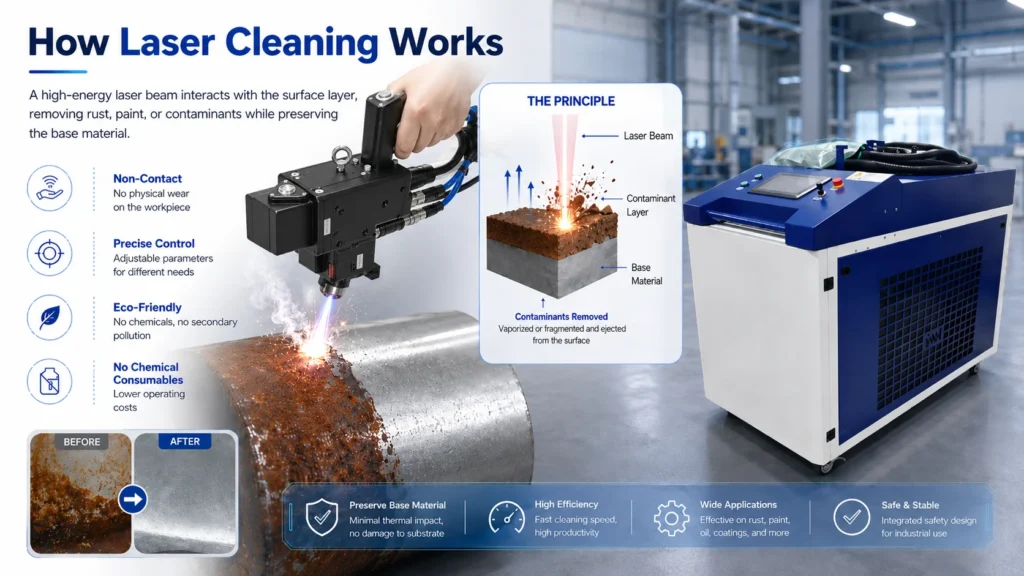
Laser cleaning is a non-contact way of removing rust, paint, oxide and other contamination from a surface using a focused laser beam, with no grit, chemicals or physical scrubbing. It works because the beam is absorbed by the contamination far more strongly than by the clean material underneath, so the unwanted layer heats up, vaporises and is ejected while the base material is largely left alone.
Key Considerations
So how does laser cleaning work in practice? The mechanism, in plain terms, is laser ablation. A short, intense burst of light lands on the surface and is soaked up by the rust or coating. That energy heats the layer so fast that it turns to vapour and fine particulate and lifts away — sometimes with a small shockwave that helps flick it off. The clean metal beneath reflects more of the light and absorbs less, so it heats far less and stays intact. Get the energy right and you remove the contamination and stop there.
Key Specifications & Performance
Two things let an operator control the result. The first is power and pass speed, which set how much energy reaches the surface. The second is the beam mode: pulsed beams deliver short bursts with cooling gaps, which protects delicate surfaces, while continuous beams run steady and clear thick layers faster. Most industrial systems use a 1064 nm fiber source, because that wavelength is absorbed well by rust and oxide on metal.
In Practice
Why does any of this matter to a buyer? Because the same principles explain the benefits people notice: no abrasive eating into the part, no chemical waste to handle, and a dry surface ready for the next step. It also explains the limits — very thick, flaking layers may need more than one pass, and delicate substrates need a gentle setting. Understanding the process is the first step to choosing the right machine, which the product pages cover in detail.
Comparison
| Step | What happens |
|---|---|
| 1 Incidence | Contamination strongly absorbs the beam |
| 2 Vaporise | Layer flash-heats, vaporises and ejects |
| 3 Selectivity | Substrate reflects more, heats less, stays intact |
| 4 Capture | Vapour/particulate is extracted |
Related
The Laser Cleaning Process, Explained Step by Step · Laser Cleaning Machine
Laser cleaning wins when you want to remove rust or coating without media, chemicals or damage to the base metal. Pulsed and continuous modes suit different surfaces — that’s the key decision.
Wang Jiachao — Senior Laser Equipment Engineer, Technical Department Manager · 16 years experience