
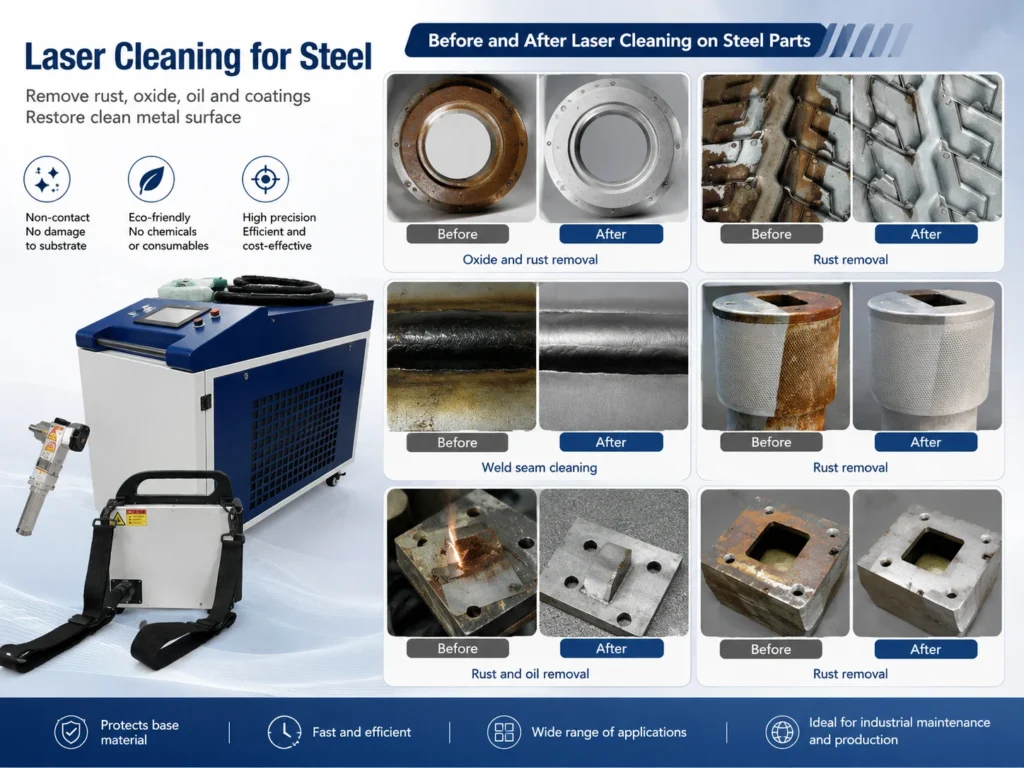
Metal is what laser cleaning does best. A laser steel cleaning machine lifts rust, mill scale, oxide and coatings off carbon steel, stainless and cast iron without grit or chemicals, and because the beam is selective it leaves the bare metal underneath largely untouched. For weld prep, restoration and surface finishing, that is exactly the result you want.
Key Specifications & Performance
The reason it works so cleanly is the wavelength. A 1064 nm fiber beam couples strongly into oxide and contamination while metal reflects more of the energy, so the rust vaporises and the steel stays put. Carbon steel takes higher power for heavy scale; stainless wants a touch less to avoid heat tint on the finish; cast iron, being porous, often needs a slower pass to clear scale from the surface.
Key Considerations
A typical metal-cleaning sequence:
How It’s Done — Step by Step
1. Identify the metal and the contamination — rust, scale, paint or oxide. 2. Set power and pass speed conservatively, more so on stainless. 3. Work overlapping passes until the surface flashes to bare metal. 4. Inspect for heat tint on stainless; back off power if you see it. 5. Move to weld, coat or finish while the surface is clean.
Voltage & Regional Fit
One honest note: very thick, flaking scale may want a quick mechanical knock-back first, and a mirror-polish finish needs careful settings. We tell partners that rather than promise one pass on everything. Machines ship CE-marked ; Gulf registration steps are scoped per destination.
Comparison
| Metal | Setting | Watch |
|---|---|---|
| Carbon steel | Med-high power | Raise power for scale |
| Stainless | Lower power | Avoid heat tint |
| Cast iron | Slow pass | Porous; stubborn scale |
Related
Material-Specific Laser Cleaning · Laser Rust Removal Machines
1-year warranty; installation, training & after-sales support available.