
Laser cleaning stone and concrete removes soiling, biological growth, carbon crust, paint and atmospheric grime without grit, water blasting or chemicals — and without eating into the surface. On heritage masonry, where the stone itself is what you are trying to preserve, that gentleness is the entire reason to use a laser.
Applications & Use Cases
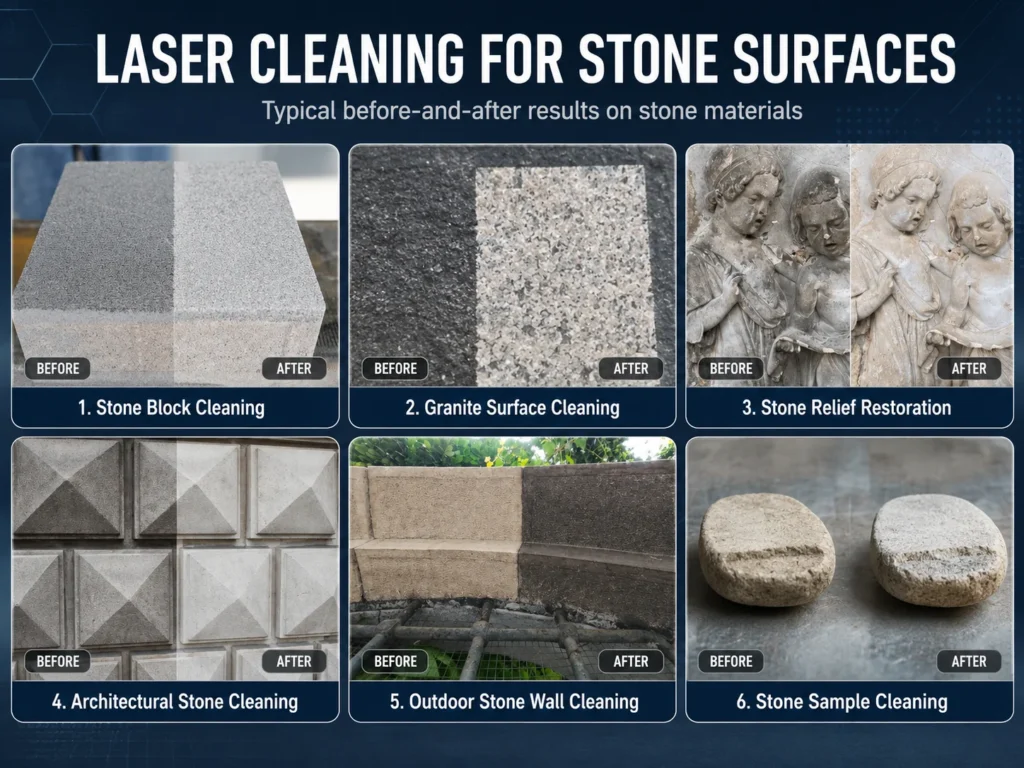
Mineral surfaces behave differently from metal. They are porous and can hold layers of dirt, lichen and old coatings, all of which the beam lifts cleanly. The care here is thermal rather than mechanical: some stones are heat-sensitive and can spall or discolor if pushed too hard, so conservation work runs at conservative settings and proves them on a hidden patch first. Concrete is more robust but still benefits from a controlled, dry process that leaves no runoff to manage.
Key Considerations
A sensible sequence on masonry:
How It’s Done — Step by Step
1. Identify the substrate — stone type or concrete — and how sound it is. 2. Trial a discreet patch at low power and confirm no spalling or discoloration. 3. Step power up gradually; let the crust lift rather than forcing it. 4. Extract the fine debris and inspect the cleaned area. 5. Record the settings, especially on protected or listed structures.
Voltage & Regional Fit
Honest caveat: friable or already-spalling stone needs specialist judgement, and deeply set staining may not clear in a single pass. We flag that on delicate work rather than over-claim. Machines ship CE-marked ; Gulf registration is scoped per destination.
Comparison
| Surface | Removes | Watch |
|---|---|---|
| Stone (heritage) | Bio growth / crust / coating | Avoid spall; test first |
| Concrete | Coating / soiling | Robust; dry, no runoff |
Related
Material-Specific Laser Cleaning
1-year warranty; installation, training & after-sales support available.