
Desktop UV Laser Marking
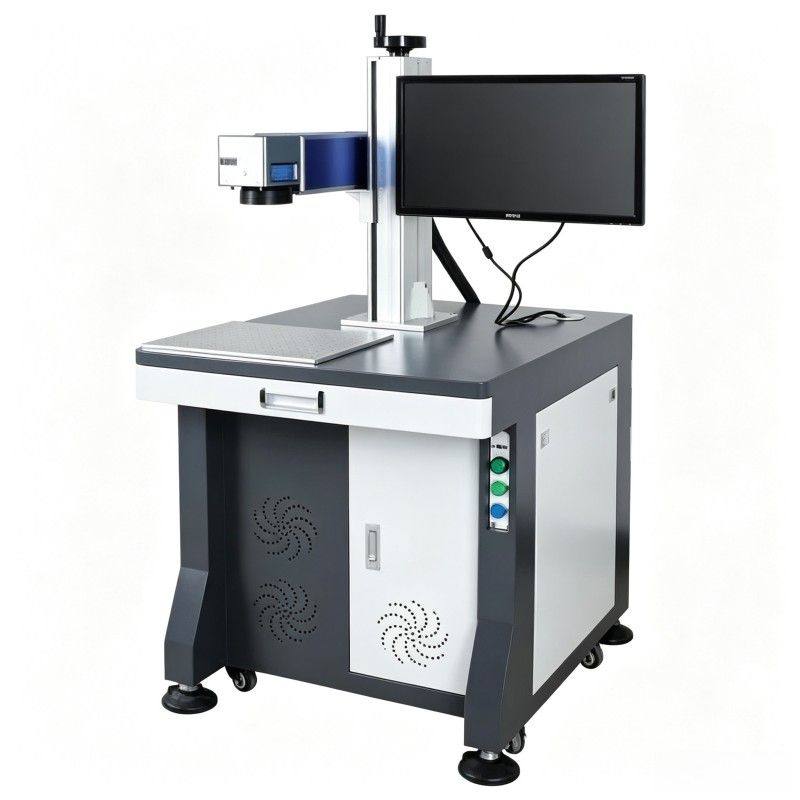
A 355 nm ultraviolet marking station for ultra-fine, permanent marks. UV is a “cold” process with a very small heat-affected zone — ideal for glass, plastics, thin films, electronics and other sensitive materials where infrared or ink marking struggles.
Range
Models & Configurations
One desktop platform across a 3–20 W power range — matched to your material and detail. Water-cooled builds cover the full range; compact air- or water-cooled builds cover 3–10 W.
Fine marking
Glass, LCD screens, thin ceramics and other delicate materials; ultra-fine detail.
General purpose
Everyday marking of metals, plastics, cables and packaging at production speed.
Higher throughput
Deeper, faster marking and higher volumes; water-cooled for sustained output.
Why UV
Built for Ultra-Fine Marking
The features that make UV marking precise, stable and easy to run.
Ultraviolet light with a tiny heat-affected zone for ultra-fine marks on sensitive materials.
Metal-body galvanometer with built-in dual red-light guides — adjustment-free and stable.
Long-life industrial UV source with ≤3% output power stability.
Full English Windows software, standard USB input and full font-library support.
What It Is
What Is a Desktop UV Laser Marking Machine?
A desktop UV marker uses a 355 nm ultraviolet laser source and a metal galvanometer to place a very small, focused spot on the material surface. Because most materials absorb ultraviolet strongly, marking is a “cold”, low-heat process: the heat-affected zone stays extremely small, so you can mark glass, LCD panels, thin ceramics, semiconductor wafers, sapphire, polymer films, plastics and coated metals with fine, permanent, high-contrast results. The whole system is an integrated cabinet — UV source, cooling, metal dual-red-light galvo, industrial PC and display — with a small footprint that sits on a bench.
Specifications
Key Specifications & Performance
Shared specifications across the desktop UV range; power-dependent figures are noted.
| Feature | Detail |
|---|---|
| Laser power | 3 / 5 / 8 / 10 / 15 / 20 W (water-cooled) · 3 / 5 / 10 W (air or water-cooled) |
| Wavelength | 355 nm (ultraviolet) |
| Beam quality (M²) | < 1.2–1.3 |
| Pulse frequency | 10–500 kHz (by model) |
| Output beam diameter | 0.7–0.8 mm |
| Output power stability | ≤ 3% |
| Source working life | ≈ 20,000 hours |
| Marking range | 100–300 mm (optional) |
| Engraving depth | ≤ 1 mm (depends on power and time) |
| Marking speed | ≤ 10,000 mm/s |
| Repeat accuracy | ± 0.002 mm |
| Min line width / character | 0.01 mm / 0.03 mm |
| Cooling | External water; compact builds offer built-in air cooling |
| Power supply | 500 W · 220V · 50 Hz (110V connectable) |
| Operating environment | 5–35 °C, 30–85% RH, no oil mist or condensation |
| Operating system | Windows |
| Dimensions / weight | 800 × 660 × 1425 mm · ≈ 100 kg |
Marking accuracy, depth, speed and contrast vary with power and material; final settings are tuned to the actual product.
Applications
Applications & Use Cases
UV marking suits high-value, detail-critical work across many industries.
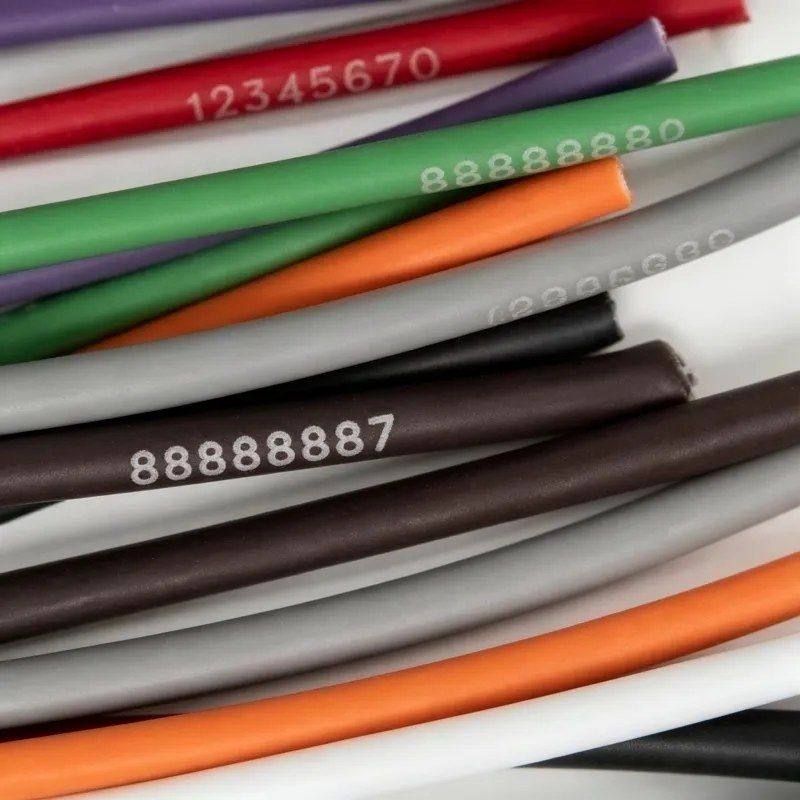
Cable & wire codingDesktop UV stationComparison
Comparison & Selection Guide
Why UV — and how to choose a power level.
Choose 3–5 W for the finest detail on delicate materials, 8–10 W for general daily marking, and 15–20 W for deeper, faster, higher-volume work.
Compliance
Certifications & CE Compliance
CE conformity coverage is available on request.
Installation
On-boarding support for your team.
Training
Operator training on the Windows marking software.
After-sales
Ongoing support and spare parts, worldwide.
1-Year Warranty
Warranty with installation, training and after-sales.
Get Started
Get a Quote on Your Desktop UV Marker
Tell us your material and the detail you need and we’ll recommend the right UV power level.