
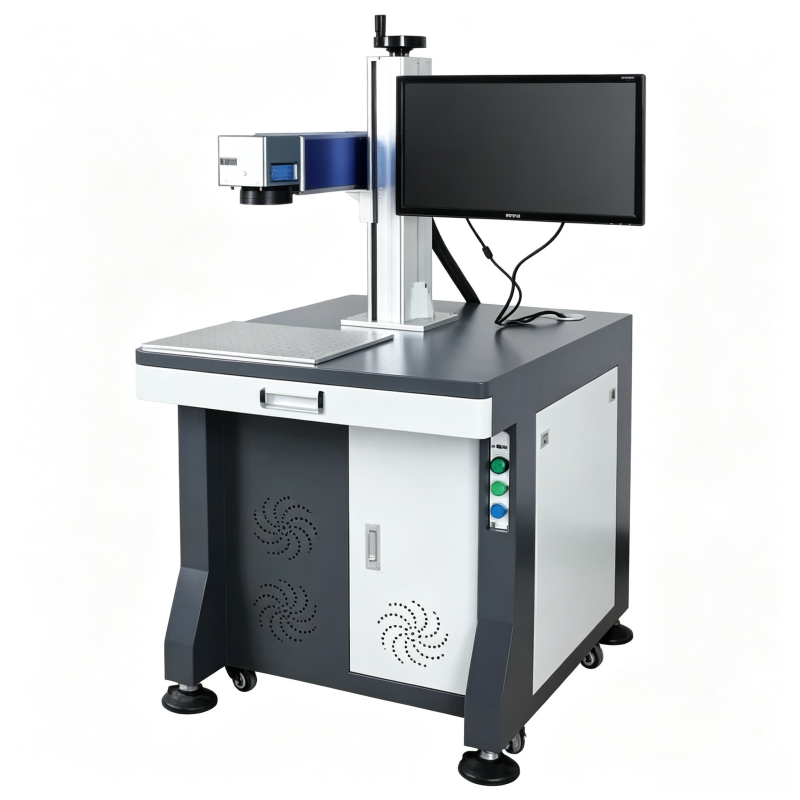
Overview
When date codes and batch marks have to go onto packaging at full line speed — and the material can’t take heat — a UV flying machine is the answer. It codes parts on the move, cold, at up to 200 m/min.
Why UV Flying Works
The marking head keeps pace with the conveyor, so production never stops to mark. At 355 nm the mark forms cold, which is what lets it run on heat-sensitive plastics — PPR, PVC and PE pipe, plastic film and bottle caps — without melting or warping them. The frame moves up, down and side to side, and the head rotates 360° to reach the print line.
Built to Last
The mark is a change in the surface itself, not ink on top, so it won’t smear, wash off or rub away — and it leaves no solvent residue, unlike inkjet coding. That’s why it’s trusted for date, batch and traceability marks in food, beverage, pharma and cosmetics.
Specs That Matter
UV flying build; values model-dependent, confirmed per order.
| Parameter | Value |
|---|---|
| Wavelength | 355 nm (UV) |
| Output power | 3W / 5W / 10W |
| Beam quality M² | ≤ 1.2 |
| Pulse frequency | 20–300 kHz (model-dependent) |
| Output beam diameter | 0.7–0.8 mm |
| Inline marking speed | up to 200 m/min (single-line 2 mm characters) |
| Galvo scan speed | up to 10,000 mm/s |
| Marking field | 100–300 mm (range optional) |
| Repeat accuracy | ± 0.002 mm |
| Minimum line width | 0.1 mm |
| Minimum character height | 0.15 mm |
| Source working life | about 20,000 hours |
| Cooling | air-cooled or water-cooled (model-dependent; chiller included on water-cooled builds) |
| Operating system | flying marking system |
| Power supply | 500W / 220V / 50Hz (110V connectable) |
| Dimensions / weight | 660×510×1460 mm / ≈ 89 kg (incl. water tank) |
Model & Source Reference
| Model | Power | UV source | Cooling |
|---|---|---|---|
| UV300F | 3W | JPT UV source | air-cooled |
| UV500F | 5W | JPT UV source | air-cooled |
| UV300 / UV301 | 3W | JPT UV source | water-cooled |
| UV500 | 5W | JPT UV source | water-cooled |
| UV1000 | 10W | JPT UV source | water-cooled |
How an Inline Job Is Set Up
- Mount the head over the conveyor and set the focus to the part.
- Import the code file and set pulse, speed and frequency.
- Run a sample at line speed, check contrast, then save the recipe.
- Tie the trigger to the line sensor and encoder.
- Run production and scan codes inline.
CE Compliance
Every machine ships CE-marked, with conformity documentation available on request. We never claim SASO, SABER, GCC or UKCA we do not hold.
Getting It Right Before You Buy
Send us your part and line speed. We’ll mark a sample at speed, show you the result, and quote against it — so the cycle you plan around is the one you get.
Request a Quote · Download the Spec Sheet
Explore: UV Laser Marking. Related: Industrial Marking.
1-year warranty; installation, training & after-sales support available.