
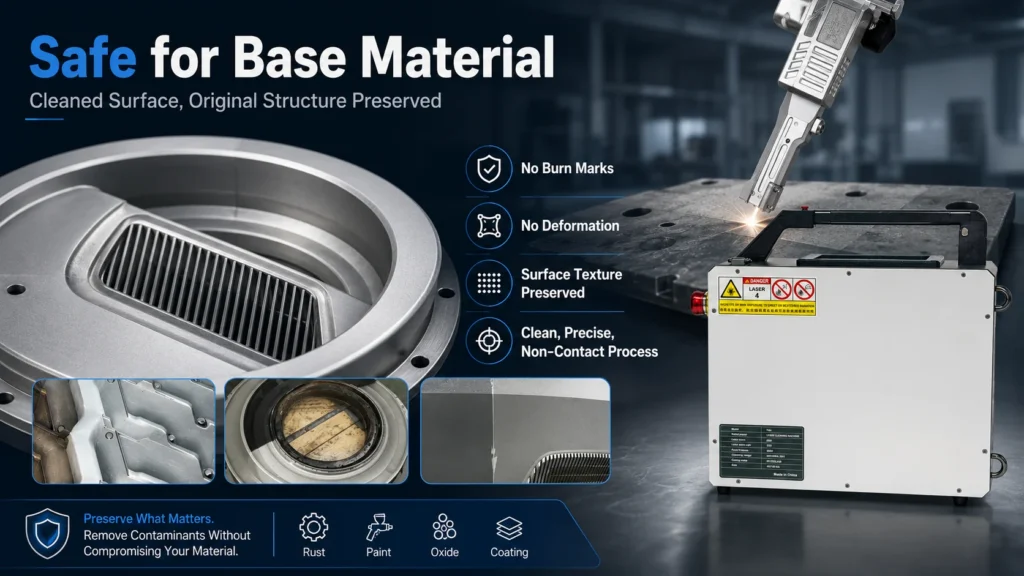
For most work, laser cleaning is gentler on the substrate than sandblasting or other abrasive methods, because nothing physically strikes the surface. The beam removes the contamination and is largely reflected by the clean metal underneath. So the base material is not worn, pitted or reshaped the way grit blasting can do it. Set correctly, it cleans without changing the part.
Applications & Use Cases
This is the single biggest question buyers ask, and it deserves a straight answer rather than a sales line. When you weigh laser cleaning vs sandblasting, it comes down to contact. Sandblasting throws abrasive at the surface. That removes contamination, but it also wears the substrate, roughens it and can warp thin sheet. A laser does none of that by force — it targets the dirt layer with energy the clean metal mostly reflects. That is why it is trusted on moulds, thin panels, polished stock and heritage surfaces, where abrasion is not an option.
Where It Fits
There are honest limits, and we would rather state them. Push the power too high or dwell too long and any process can mark a surface. Heat-sensitive thin stock and certain stones need low settings and a test on a hidden area first. The point is that laser gives you the control to stay safe — control that abrasive blasting simply does not offer. The sub-pages compare laser against sandblasting and dry-ice in detail, and show before-and-after results.
Key Considerations
These machines are CE-marked. The safety case covers the operator as well as the part — the enclosure, interlocks and extraction are all listed. The product pages cover setup; this section is about whether the process is safe for what you are cleaning.
Comparison
| Dimension | Laser cleaning | Sandblasting |
|---|---|---|
| Contact | Non-contact, no media | Media impact |
| Substrate | No abrasion / distortion | Abrades; thin sheet can distort |
| Control | High; layer-selective | Coarser |
| Sensitive surfaces | Mold / thin sheet / polished / heritage | Limited |
| Watch | Over-power / dwell can still mark | — |
Related
Laser Cleaning vs Sandblasting and Dry-Ice Blasting · Is Laser Cleaning Safe for the Substrate? · How Does Laser Cleaning Work?
Reviewed by Wang Jiachao (王加超), Senior Laser Equipment Engineer, Topstar.
1-year warranty; installation, training & after-sales support available.