
Overview
A code only earns its place if a scanner reads it the first time, every time. Laser marking gives the contrast and cell sharpness that 2D readers need — permanently.
Why Laser Codes Scan Reliably
The laser places sharp, evenly-spaced cells with strong contrast against the substrate, which is what a QR or Data Matrix reader depends on. Because the mark is in the surface, the code doesn’t fade, smear or peel, so read rates hold up over the product’s life. Fiber handles metal; UV handles PCB and sensitive parts; CO2 handles non-metal.
Built to Last
The code is a change in the surface itself, not ink, so it survives handling, cleaning, heat and time — and stays scannable.
Specs That Matter
Source matched to substrate (fiber / UV / CO2), small spot and high contrast for tight cells, fields 100–300 mm. UV resolves the finest codes (down to 0.01 mm line width) for dense boards.
How a Code Is Set Up
- Fixture the part and set the focus.
- Generate the QR / Data Matrix / barcode and set parameters for the substrate.
- Mark a sample and verify it scans with your reader.
- Lock the recipe and set repeat positioning.
- Run the batch and grade codes against your read-rate target.
Applications
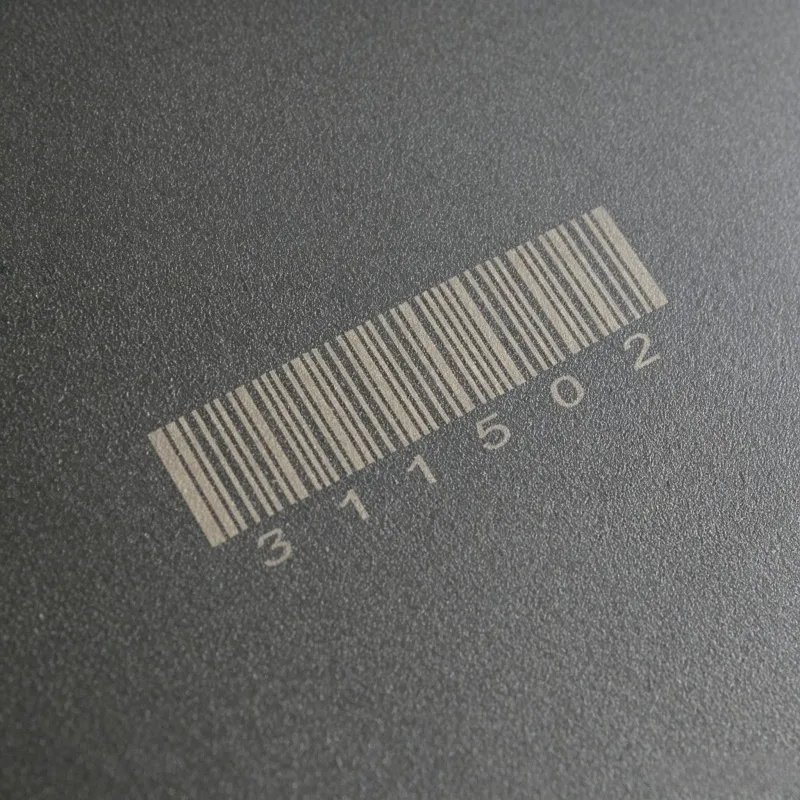
2D codes on metal parts, PCB and FPC traceability codes, packaging barcodes, glass and plastic codes, asset tags.
CE Compliance
CE-marked, with conformity documentation available on request. We never claim SASO, SABER, GCC or UKCA we do not hold.
Getting It Right Before You Buy
Send us your part and code spec. We mark a sample, verify it scans on your reader, then quote against it.
Request a Quote · Download the Spec Sheet
Explore: QR Code Marking. Related: PCB Marking · Metal Marking.
1-year warranty; installation, training & after-sales support available.