In short: Sandblasting is a surface treatment in which abrasive media is fired at a part under compressed air to strip away rust, scale, paint or old coating — and, as a side effect, to leave the surface rougher than it was. Everything that makes it useful and everything that makes it wrong for certain parts comes from that one mechanism.
How Sandblasting Works
A blast pot holds the abrasive. Compressed air carries it through a hose and out of a nozzle at high velocity, and each particle chips away a little of whatever it lands on. The operator controls the result with air pressure, nozzle size, standoff distance and the angle of attack, and with the media itself.
The process does not distinguish between contamination and the material underneath. That is why it clears heavy scale quickly, and why it always takes some parent material with it.
The Media Decides the Outcome
The name says sand, but silica sand is now avoided in most industrial settings because the dust is a respiratory hazard. What is actually used varies with the job:
- Garnet and aluminium oxide cut fast and leave a sharp profile for coating adhesion.
- Steel grit and shot suit heavy structural work and recycle well.
- Glass bead peens rather than cuts, leaving a smoother, satin surface.
- Softer media such as walnut shell or soda strip coatings while going easier on the substrate.
Changing media changes the finish, the cycle time and the waste stream. It does not change the fact that the surface is being mechanically worked.
What Sandblasting Does Well
Blasting is hard to beat on large, heavily corroded steelwork: beams, frames, tank shells, ship sections. It covers area fast, the equipment is cheap to buy, and a rough anchor profile is exactly what a paint or coating system wants before it is applied.
It also reaches shapes a beam cannot, because the media bounces into corners and cavities.
Where Sandblasting Costs You
Media becomes waste. Every kilogram used has to be contained, collected and disposed of together with whatever came off the part.
The surface changes. Dimensions and finish shift, which matters on machined faces, mould cavities and thin sheet, where prolonged blasting can warp the part.
Contamination transfers. Media that has touched carbon steel leaves iron particles in stainless steel, and those rust later.
Containment is the hidden job. Inside a working plant, screening off the work area is often harder than the blasting itself. In a hall that runs other work, that usually means blasting gets scheduled for a shift when nothing else is in there.
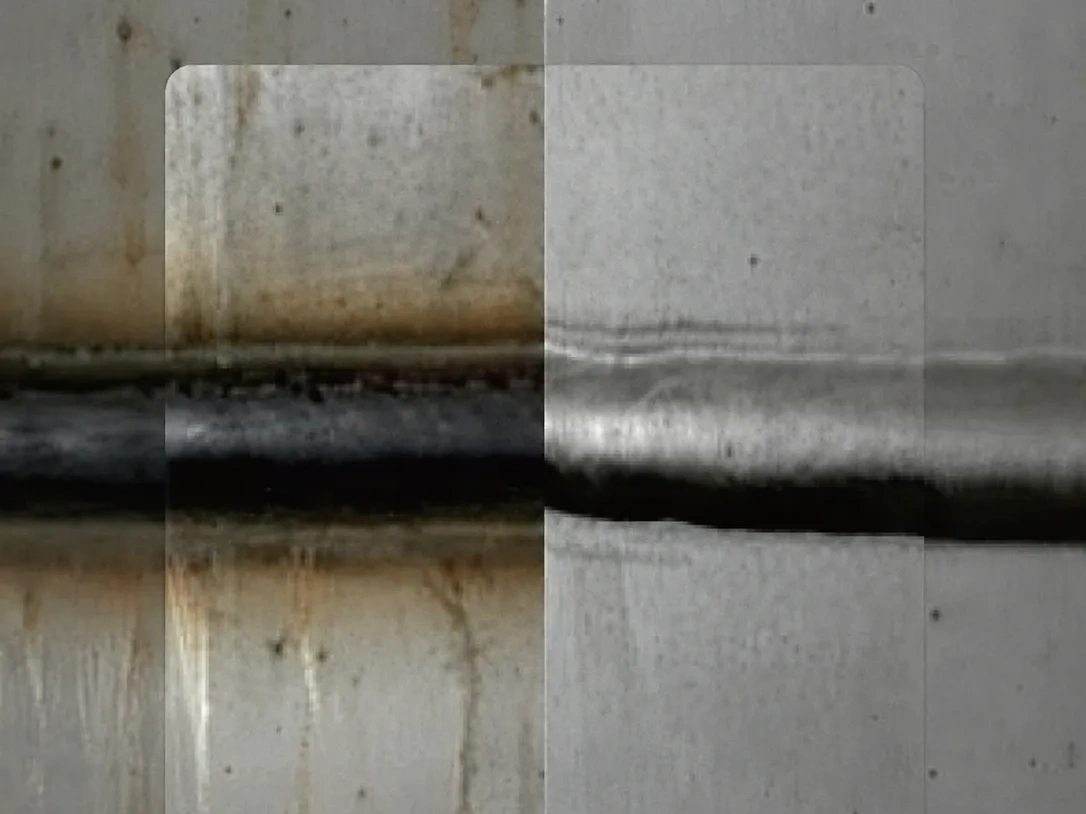
Sandblasting or Laser Cleaning: How to Decide
| Sandblasting | Laser cleaning | |
|---|---|---|
| Mechanism | Abrasive impact | Optical absorption by the contaminant layer |
| Surface after | Roughened anchor profile | Substantially unchanged |
| Consumables | Media, continuously | None |
| Waste | Spent media plus removed material | Extracted fume |
| Set-up | Enclosure or screening | Localised extraction |
| Repeatability | Operator technique | Stored parameters |
| Best at | Large corroded structures, pre-coating profile | Precision parts, moulds, stainless, repeat work |
The line falls here: if the part is about to be painted and wants a profile, blasting is still the right tool. If the part has to keep its dimensions or finish, or the plant cannot live with loose media, laser cleaning changes the arithmetic.
Narrowing It Down on the Laser Side
If laser looks like the better fit, the choice is smaller than it first appears. For rust, oxide and coating removal, pulsed laser cleaning machines come in 50 W and 100 W, both at 1064 nm, both air-cooled, both with output adjustable across a 10–100% range. The 100 W unit removes a given layer faster; the 50 W unit is lighter and gentler on thin or delicate substrates.
On the equipment side that comes with real constraints. The scan field is 100 × 100 mm and the head is a 2D galvo, so a large face is covered pass by pass rather than in one sweep, and that is what sets your cycle time. Fibre reach on the backpack configuration is 3 m with the head itself under 1.5 kg, so the machine goes to the part rather than the part to the machine. It is a Class 4 laser, so the work area needs enclosure or controlled access and eye protection, in the same way blasting needs containment. Mains supply is 220 V and the draw is in the hundreds of watts, nothing like the compressor service a blast setup needs.
Machines are CE marked, with FDA and SGS documentation available on request. Anything beyond these figures — throughput on your particular coating, for instance — depends on configuration and is confirmed per order.
Still deciding? The coating question usually settles it: if the part goes straight into paint, you want the profile blasting leaves. If it does not, send a photo of the part and say what is on it and what the surface has to look like when you are finished. Talk it through with us
Choosing for Your Own Parts
Run the part past these:
- Does the surface have to keep its dimensions or finish? If yes, blasting is out, and laser rust removal is the direct comparison.
- Is the part going straight into coating? If yes, you need the anchor profile, and blasting stays.
- Is this a one-off or a repeat job? Media and disposal cost scale with every hour of blasting; a stored laser parameter set pays back only when the same work comes round again.
Common Questions
Is sandblasting the same as shot blasting?
No. Sandblasting propels abrasive with compressed air; shot blasting throws steel shot mechanically with a wheel. Shot blasting is faster on large flat steel, air blasting is more controllable on complex shapes.
Does sandblasting remove rust completely?
It removes the oxide it can reach. Pitted corrosion holds rust below the original surface, and blasting opens the pits rather than clearing what sits inside them.
Can sandblasting be used on stainless steel?
Only with media reserved for stainless. Media that has previously blasted carbon steel leaves iron particles behind, and those corrode later.
Is laser cleaning always better than sandblasting?
No. On very large, heavily corroded structures where finish does not matter, blasting is usually cheaper per square metre. Laser wins where the substrate, the dimensions or the waste stream are the constraint.
Related
Equipment
Further reading
- Is Laser Cleaning Safe for the Substrate?
- Laser Cleaning vs. Sandblasting: A Practical Comparison for Rust and Coating Removal
Get in touch
- Contact Topstar to discuss which method suits your parts and throughput.