In short: Resistance spot welding joins overlapping metal sheets by squeezing them between two copper electrodes and passing a heavy current through the stack for a fraction of a second. The sheets resist the current most where they touch, so a small lens of metal melts there and freezes under pressure into a weld called the nugget. It needs no filler or gas and suits thin steel lap joints made in volume; laser welding becomes the better choice when only one side is reachable, the joint has to be a continuous seam, or the visible face must stay unmarked.
Most car bodies are still held together by several thousand spot welds each, and the same process builds appliance cabinets, electrical enclosures and steel furniture.
How a Spot Weld Forms
Each weld runs through a short, fixed sequence. The electrodes close on the sheets and build up force, current flows for a set time, and the force stays on while the nugget freezes before the electrodes lift. Each stage has its own setting, usually counted in cycles of the mains frequency.
Heat comes from resistance, and resistance is highest at the interface between the two sheets, which is why the nugget forms deep inside the stack instead of at the surface. The electrodes are copper alloy and water-cooled, so the faces touching them stay well below melting point even though the metal a millimeter away is liquid.
Nugget size is what decides strength. Specifications usually tie the minimum diameter to the square root of the sheet thickness, and a weld that falls short counts as defective even if it looks fine from outside.
Where Spot Welding Earns Its Place
Speed and simplicity. A single weld takes well under a second, there is no wire, flux or shielding gas, and the electrodes pull the sheets into contact on their own, so small gaps between parts close up as the gun squeezes. A robot or a fixed press can repeat the same weld thousands of times a shift.
The weak point is the electrode tip. As it wears, the face spreads and flattens, the same current covers a larger area, and the nugget shrinks. Welds that were sound when the shift began can come out undersized by its end with no change in settings. Lines deal with this through regular tip dressing and weld schedules that raise the current step by step as the tips age. Galvanized coatings make it worse: zinc alloys with the copper and tips wear noticeably faster, so dressing intervals get shorter.
The quickest check is still destructive. Weld a pair of test coupons, peel or chisel them apart, and look at what is left: a good weld tears a round button out of one sheet, while a weak one separates at the interface with little or nothing pulled out.
Where It Runs Into Limits
Access comes first. The electrodes have to reach both sides of the joint, so closed sections, tubes and box structures welded from outside are difficult or impossible.
The joint has to be a lap joint with a flange wide enough for the electrode tip, which adds material and weight that a butt or fillet joint would not need. Spot welds are separate points, so a seam that has to hold liquid or gas needs sealant on top. Each spot also leaves an electrode mark, which is acceptable inside a cabinet but shows on a brushed stainless door.
Aluminum is the hardest common case. It conducts heat and electricity so well that it needs far more current than steel, its oxide layer makes contact resistance erratic, and it sticks to the electrode tips quickly. Welds placed close together cause a problem of their own: part of the current shunts through the neighboring weld instead of the new one, which sets a minimum spacing between spots.
Spot Welding and Laser Welding Side by Side
| Resistance spot welding | Laser welding | |
|---|---|---|
| Access | Both sides of the joint | One side |
| Joint types | Lap joints only | Lap, butt, fillet and edge joints |
| Weld form | Separate spots | Continuous seam, stitches or spots |
| Flange | Wide enough for the electrode | Can be narrower |
| Surface | Electrode mark on both faces | Narrow bead on one face |
| Gap between parts | Closed by electrode force | Has to be held by the fixture |
| Consumables | Electrode caps | Shielding gas, protective lenses, wire if used |
| Best fit | High-volume steel lap joints | Sealed seams, one-sided access, visible faces |
The row that catches people out is the gap.
What Changes When a Part Moves to Laser
Fit-up becomes your responsibility. A spot welding gun presses the sheets together; a laser beam does not, so whatever gap the parts arrive with is the gap the weld has to bridge.
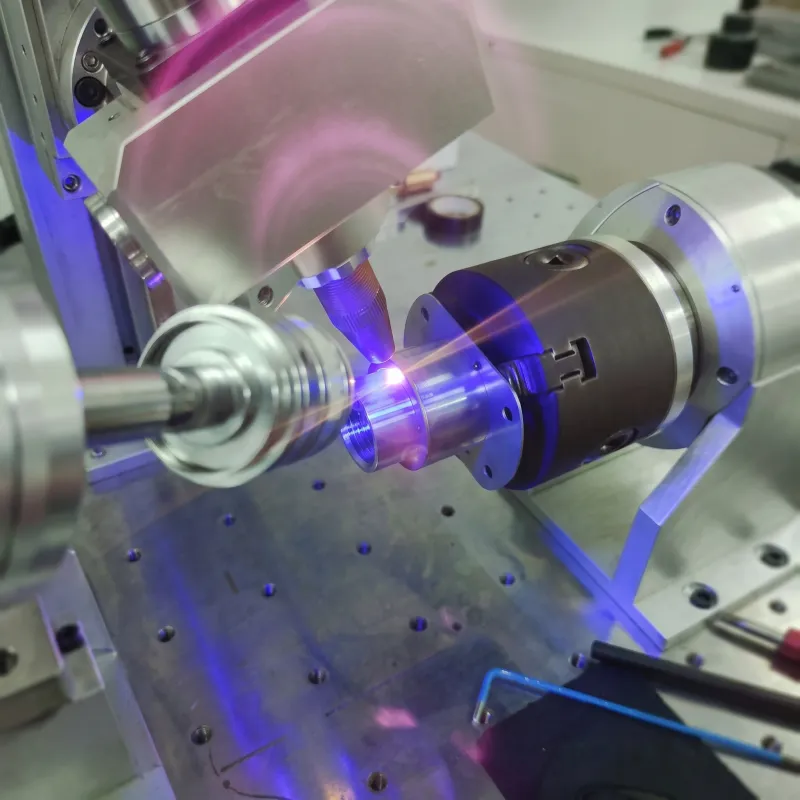
On our automatic platform laser welder, a self-fused seam, welded without wire, tolerates a gap of no more than 15% of the plate thickness. On 1 mm sheet that leaves 0.15 mm at most, so pressed parts that spot welded happily because the electrodes closed them up may need tighter forming, clamping close to the seam, or wire filler before they weld cleanly by laser.
Fixturing takes over from electrode force. Clamps or hold-downs have to sit close to the seam and stay there through the weld, and on a lap joint the sheets must lie flat against each other along the whole path, not just at the points where the spots used to be.
Part size decides which machine format fits. The same platform moves its head over a working range of 500 × 300 × 400 mm in a typical build, with travel configured to the part. That covers brackets, enclosure panels, housings and small assemblies; a full car side or a long cabinet frame will not fit, and that kind of work goes to a robotic laser welding cell. Our overview of laser welding machine types compares the handheld, platform and robotic formats.
Some parts get simpler in the move. With no electrodes to fit around, a flange can shrink, a closed tube can be welded from outside, and a row of spots along a tank can become one sealed seam with no sealant.
If you are weighing a move, send a drawing of the part, the material and sheet thickness, and the spot pattern you weld today. We can say whether the joints, gaps and part size suit a laser platform, or whether spot welding remains the better fit. Show us where the spots go
Choosing Between Them
Spot welding stays the sensible choice for steel lap joints made in large numbers, where both sides are reachable, marks are hidden, and a line is already paid for. Replacing a process that already works costs more than any gain in weld quality would return.
A laser earns a look when a part needs one-sided access, a sealed seam, a clean visible face, narrow flanges, or aluminum. Many shops end up running both, with spot welding on the frame and laser on the panels and seams that customers see.
Common Questions
Is spot welding the same as resistance spot welding?
In everyday use, yes: “spot welding” almost always means resistance spot welding, although a laser can also make spot-type welds.
Can a laser replace spot welds on an existing part?
Often, with a laser stitch or a short seam in place of each spot, welded from one side. The part usually needs tighter fit-up and fixturing than it did for spot welding, so trial a few real parts before changing the drawing.
How do you check a spot weld in production?
Peel or chisel a pair of test coupons at the start of each shift and after every tip dressing, and measure the button that tears out; ultrasonic testing can check welds on finished parts without breaking them.
Why do electrodes wear faster on galvanized steel?
Zinc from the coating alloys with the copper tip, so the face grows and softens faster than on bare steel and the current is spread over more area. Dressing the tips more often keeps the nugget size up.
Is a laser weld stronger than a spot weld?
It depends on the joint design. A continuous laser seam spreads the load along its whole length, while spot welds concentrate it at each nugget, so the comparison only holds for the same part under the same loading.
Related
Equipment
Further reading
Get in touch
- Show us where the spots go, with the material and sheet thickness.