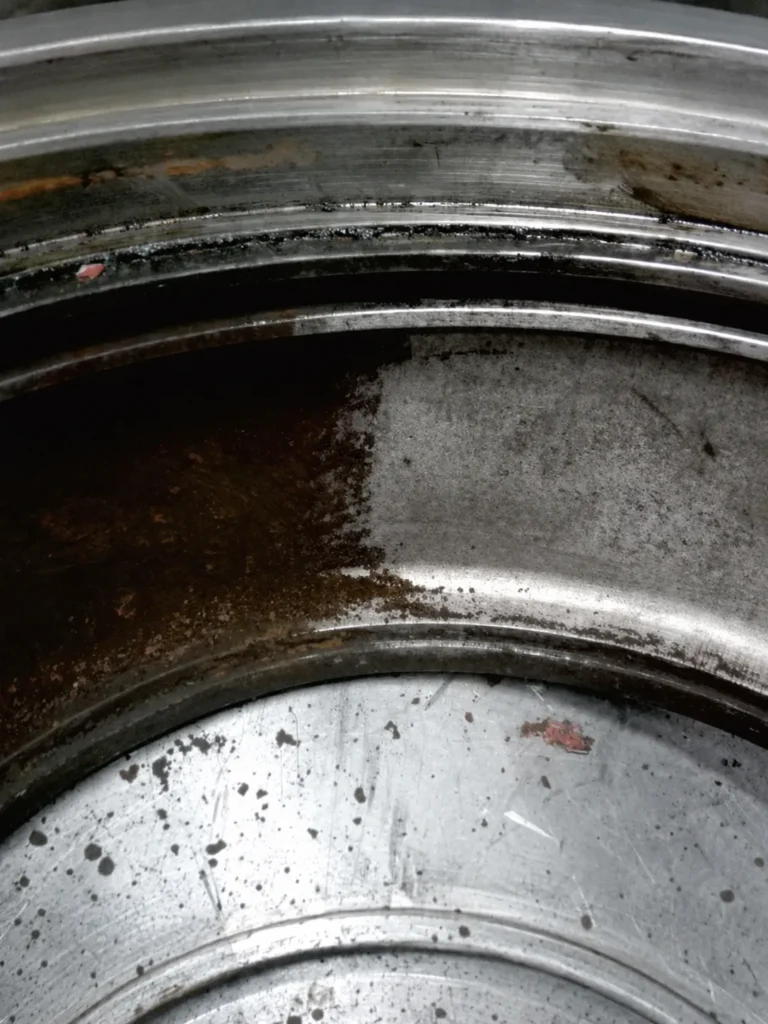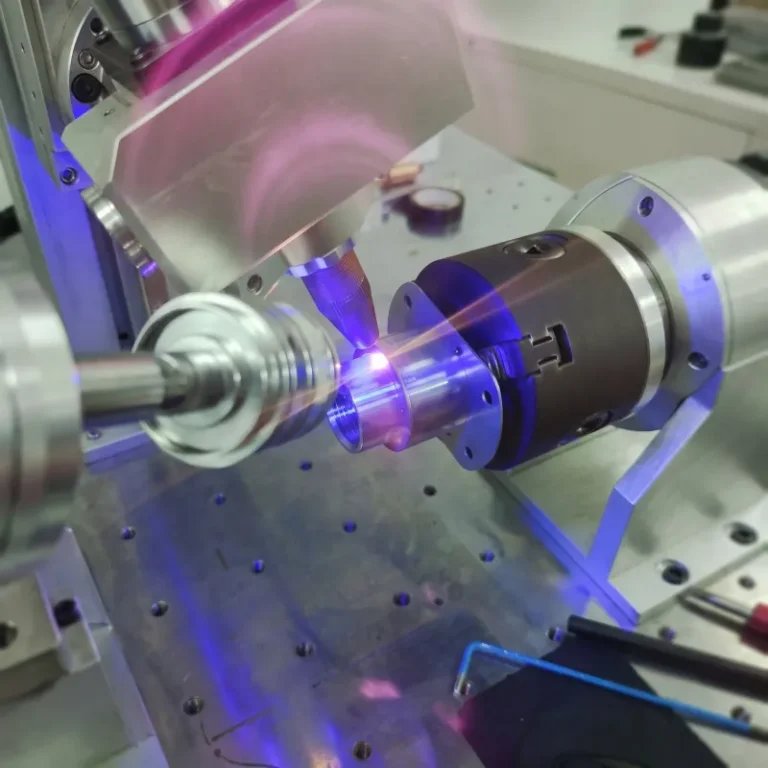
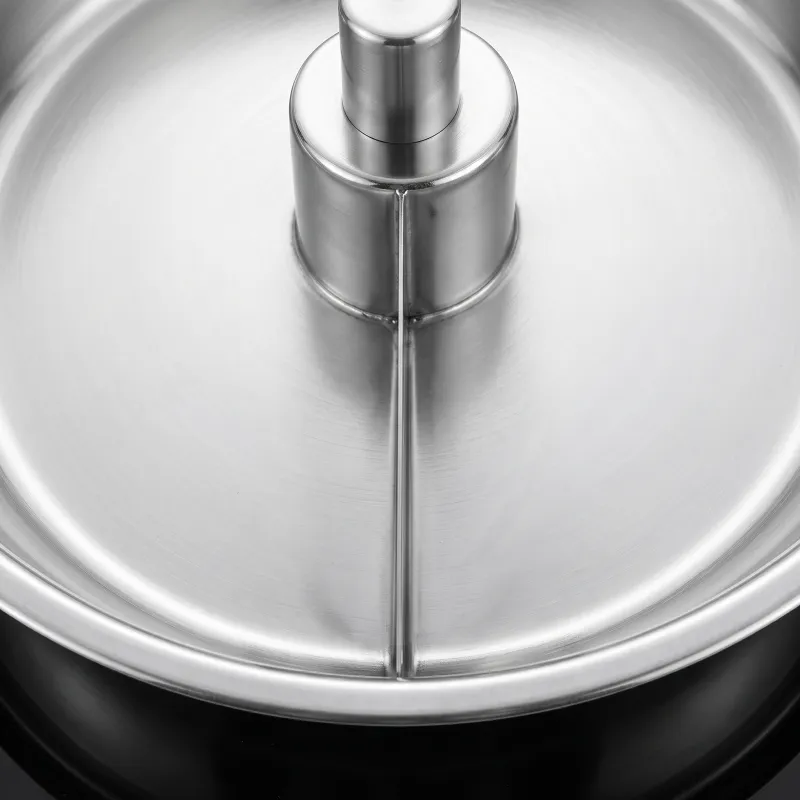
In short: To clean aluminum before welding, remove oil and grease first with a solvent that flashes off completely, then remove the oxide layer — either with a stainless steel brush used only on aluminum, or with a laser cleaner — and weld as soon as you can afterwards. The order matters: brushing an oily surface drives the contamination into the metal instead of removing it.
Why Aluminum Needs Prep That Steel Does Not
Aluminum oxide forms the moment bare metal meets air, and it keeps forming. The oxide melts at roughly three times the temperature of the aluminum beneath it, so it does not simply burn away in the weld pool. It gets stirred in instead, where it shows up as inclusions, lack of fusion, or a weld that looks acceptable and fails under load.
The second problem is hydrogen. Molten aluminum absorbs a great deal of hydrogen and solid aluminum holds almost none, so anything that carries hydrogen into the pool — moisture in the oxide layer, cutting fluid, grease, fingerprints — comes back out as gas while the weld solidifies. That gas is trapped as porosity.
This is why aluminum is unforgiving compared with carbon steel. Mill scale on steel is a nuisance; oxide and hydrocarbons on aluminum are the direct cause of most rejected welds.
The Three Prep Routes
| Method | Removes oxide | Removes oil | Leaves residue | Repeatable |
|---|---|---|---|---|
| Solvent wipe | No | Yes | Solvent film if not flashed off | Operator dependent |
| Stainless wire brushing | Yes | No — smears it in | Embedded particles possible | Operator dependent |
| Laser cleaning | Yes | Yes | None | Parameter driven |
The conventional sequence is solvent first, then mechanical.
Solvent Degreasing
Solvent handles hydrocarbons and nothing else. Use a dedicated degreaser, apply it with a clean lint-free cloth, and let it flash off completely before going further. A solvent that has not fully evaporated is itself a hydrogen source.
Stainless Wire Brushing
Use a stainless steel brush reserved solely for aluminum. A brush that has touched carbon steel transfers iron particles into the joint. Work in one direction, brush lightly, and stop when the surface goes matte — aggressive brushing burnishes the oxide back down instead of lifting it.
Laser Cleaning
A laser cleaner does both jobs in one pass. The oxide and contaminant layer absorbs the laser energy and lifts away, while the reflective aluminum beneath absorbs comparatively little. There is no abrasive, no solvent, and no spent media to collect.
What the Timing Window Actually Is
Prep does not last. Aluminum oxide begins reforming within minutes of exposure, and while a very thin fresh film is far less troublesome than an aged, hydrated one, the practical rule is to weld as soon after cleaning as the workflow allows. Parts cleaned in the morning and welded in the afternoon have been re-oxidising the whole time, and anything handled bare-handed in between has picked up new hydrocarbons. If porosity starts appearing only on the last joints of a batch, that is the window closing rather than a prep method that does not work.
Laser cleaning changes the picture because it can sit immediately ahead of the weld station rather than in a separate prep area, which shortens that window considerably.
Getting porosity on aluminum joints that are otherwise set up correctly? The cause is almost always upstream of the arc. Send the alloy, the part size and how many you run a day, and we can work out where in the prep sequence you are losing parts. Contact Topstar
Where Laser Cleaning Fits — and Where It Does Not
Laser cleaning suits aluminum pre-weld prep for specific reasons. The process is non-contact, so there is no abrasive embedding and no tool wear. Parameters are set rather than judged by feel, so the result does not vary with operator fatigue. And the only waste is the extracted fume, with no spent blast media or contaminated solvent to dispose of.
Pulsed laser cleaning machines at 50 W and 100 W run air-cooled at 1064 nm and are the gentler option where the goal is removing a thin layer without touching the substrate. Continuous laser cleaning machines are higher-power, water-cooled systems that cover larger areas faster, which matters on long seams and structural sections. Output is adjustable on both, so the energy can be matched to the layer being removed. If you are unsure which suits your parts, the trade-offs are laid out in pulsed vs continuous laser cleaning.
There is a limit to what cleaning of any kind can fix. Laser cleaning removes surface layers; it does not correct poor joint fit-up, and it will not compensate for the wrong filler alloy or unstable shielding gas coverage. If porosity persists after clean prep, the cause is downstream — gas flow, travel speed, or contaminated filler. The same prep discipline applies if you move to aluminum laser welding.
A Practical Sequence
- Degrease the joint area and at least 25 mm either side of it, then let the solvent flash off completely.
- Remove the oxide — brushed with an aluminum-only stainless brush, or laser cleaned.
- Handle with clean gloves from this point. Bare hands undo step one.
- Weld promptly. Re-clean anything that has been sitting.
- Keep filler wire capped and dry; it oxidises and picks up moisture exactly like the parent metal.
Common Questions
Does the cleaning method change the filler I should use?
No. Filler choice follows the parent alloy and the service condition, not the prep route.
Can I skip degreasing if I am laser cleaning?
For light soiling the laser handles both. Heavy oil or cutting fluid is better wiped off first — it is faster and keeps fume extraction cleaner.
Will laser cleaning thin the material?
Run at appropriate settings, the energy is consumed by the contaminant layer rather than the base metal. Adjustable output exists to match the energy to the layer being removed.
Is laser cleaning worth it for occasional work?
Probably not. The case for laser prep is consistency at volume, where operator-to-operator variation in brushing is what drives your reject rate.
Related
Equipment
Further reading
- Oxide, Weld Seam and Mold Laser Cleaning
- Laser Welding vs. TIG Welding: Which One Fits Your Workshop?
Get in touch
- Contact Topstar for configuration advice on pre-weld cleaning.