In short: Nobody can price sandblasting from the word alone. What you pay is assembled from the area to be cleaned, what is sitting on it, the finish the next process needs, where the work has to happen, and who ends up owning the spent abrasive. Move any one of those and the figure moves further than the blasting itself ever does.
That is why a blaster asks questions before giving a number, and why two quotes for what looks like the same job can sit a long way apart. What is worth understanding is not a rate but the structure underneath it, because the structure is what you can specify, negotiate or design out.
What a Quote Is Assembled From
Area, and then shape. Square meters set the baseline; shape sets how fast those meters go. A flat plate is the quick case. A lattice, a finned casting or a handrail assembly carries several times the surface its footprint suggests, and every face still has to be reached from a workable angle.
What is coming off. Light mill scale under one thin coat behaves nothing like four layers of aged paint over pitted corrosion. Removal slows as layers and hardness go up, and time is the largest single line in most quotes.
The finish that gets specified. A visual clean and a near-white blast to a written standard are different amounts of work. The cleanliness grades in ISO 8501-1 and the SSPC/NACE series exist because “clean” on its own is not a measurable instruction. Tightening the grade, or naming an anchor profile, adds passes and adds the inspection that proves they happened.
Where the work has to happen. A part that can be carried into a booth is the cheap case. Once the work is fixed in place — a structure, a tank, a machine that cannot be moved — the quote also carries mobilization, access equipment, sheeting, and the hours spent putting all of that up and taking it down again.
Containment and extraction. Loose media travels. Inside a working plant, building the enclosure can take longer than the blasting it exists to contain, and it gets priced as its own item rather than folded into a blasting rate.
Media, and what happens to it afterwards. Abrasive is consumed continuously. Some types survive several passes and can be recovered; others are single-use by design, and the choice changes both consumption and finish. Whatever is used leaves mixed with what came off the part, and that mixture is normally handled as controlled waste rather than swept up.
Why Two Quotes for the Same Job Differ
Most of the gap is scope, not margin.
Read what each one includes: masking and de-masking, the containment, access equipment, waste removal, and whether anything goes on afterwards to hold back flash rust. Freshly blasted steel starts oxidizing within hours in humid air, so the coating window belongs to the job rather than to whoever comes next.
Read the finish standard as well. If one quote names a grade and the other says “clean to bare metal”, the two are not pricing the same work, and the cheaper one gets argued about at inspection.
The Costs That Never Reach the Quote
These land on you rather than on the blaster, which is exactly why they drop out of comparisons.
Embedded media. Particles driven into a soft substrate stay there. On parts that will be plated, polished, or used in food or medical service, that turns into a rework conversation later. What blasting does to the surface is covered in what sandblasting is.
Dimensional change. Blasting takes material off and leaves a profile behind. On machined features, sealing faces and light-gauge sheet that is a tolerance question rather than a cosmetic one.
Stopped work around the job. Containment inside an occupied plant means neighboring operations pause or get sheeted. Those hours are real money even though they appear on nobody’s invoice.
Masking, every single time. Threads, bearing surfaces and sealed areas have to be protected on every run, and masking is hand work that does not get cheaper with repetition.
When Laser Cleaning Ends Up Lower Over a Year
The two methods have opposite cost shapes, and the crossover is about how often the work comes round rather than which method is better in the abstract. Blasting is cheap to start and keeps charging through media and disposal for as long as it runs. Laser cleaning puts the spend at the front and then consumes little beyond electricity and care of the optics.
So the test is annual hours together with the waste stream. Work that repeats weekly, on parts where dimensions or substrate condition matter, tends to cross over. A single job on rough structural steel does not. The full side-by-side sits in the comparison with laser rust removal and in laser cleaning against sandblasting.
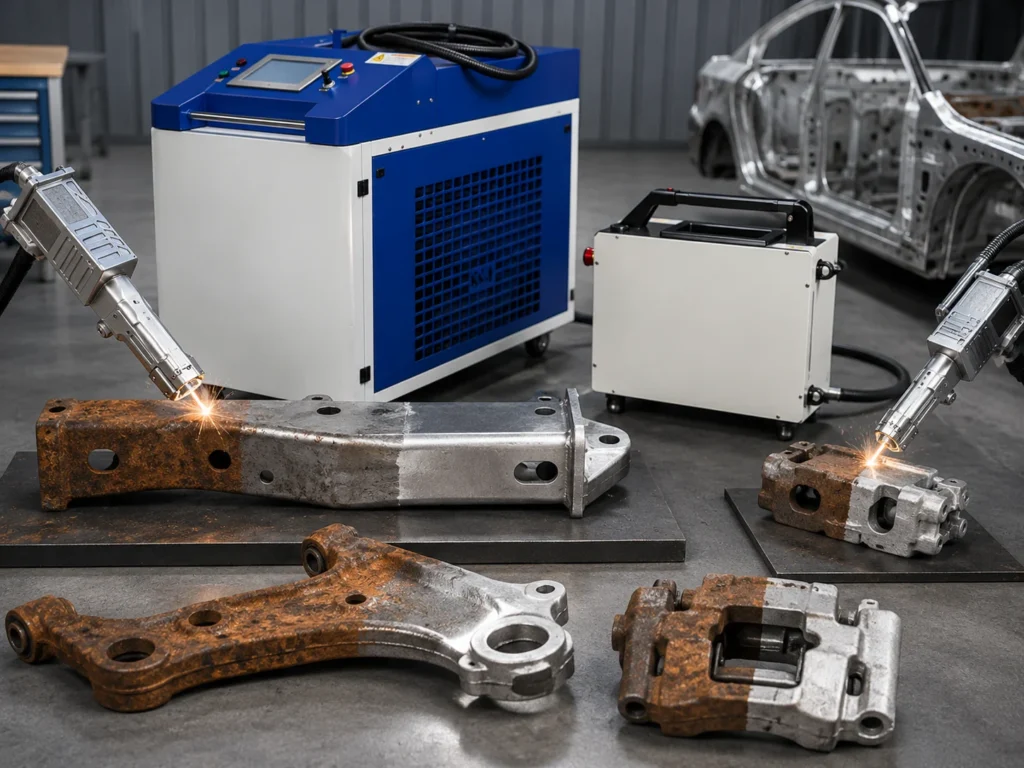
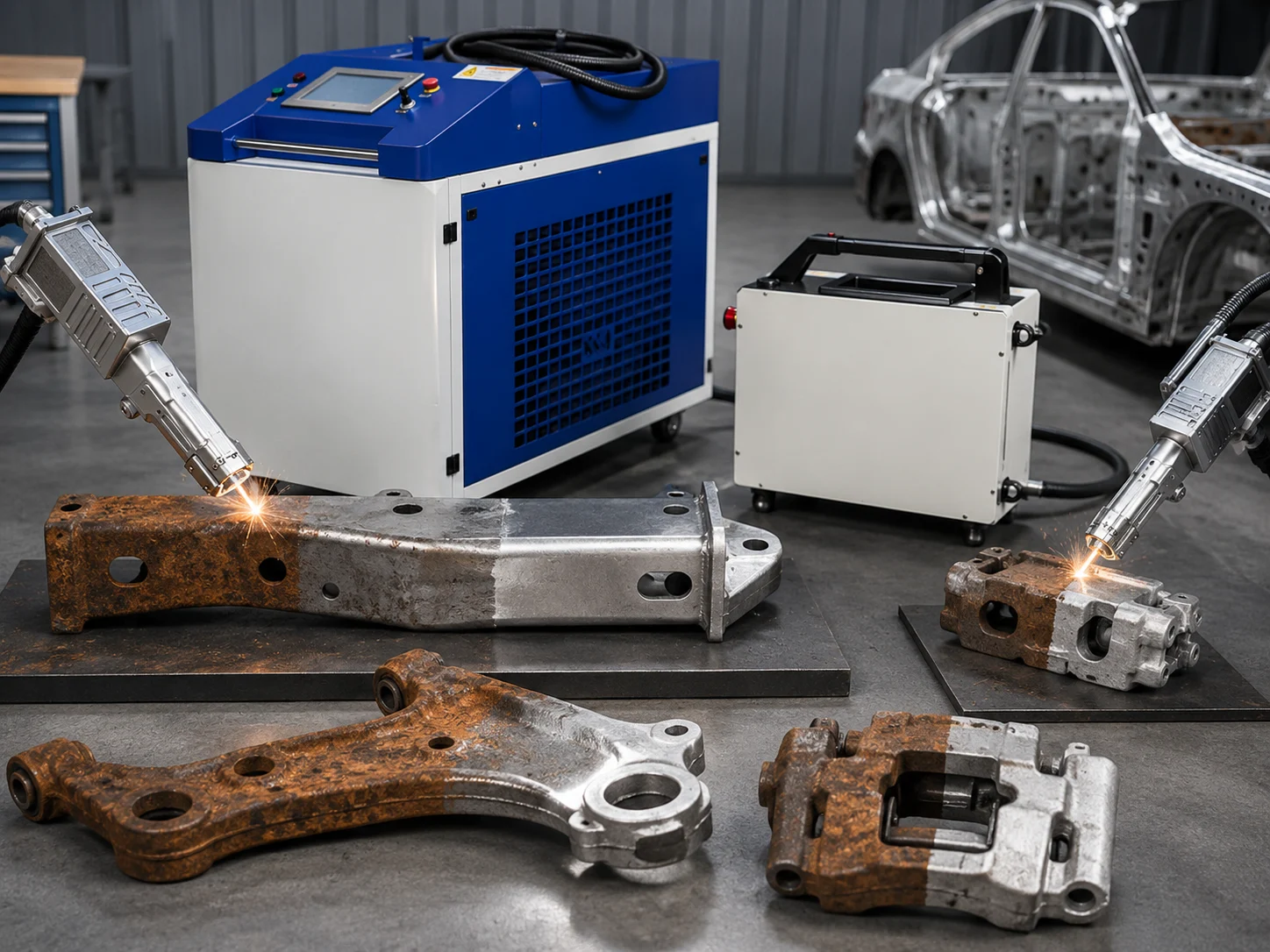
Two things about the hardware decide whether that arithmetic holds in your own plant. Our handheld laser cleaners in the backpack build weigh 7.8 kg at 50 W and 10.5 kg at 100 W and draw 350 W from an ordinary 220 V socket, so there is no compressor to hire, no media store to keep, and nothing to move to site beyond the case. Among the laser cleaning machines, the continuous handheld units put a 0.7 kg head on a 10 m fiber, which is what lets the unit stay parked while the operator walks the work instead of the part being carried to a booth. Both carry a 12-month warranty, and neither consumes anything you buy again by the sack.
If a blasting quote is already sitting on your desk, the useful next move is to set that same job against a laser figure using your own hours and your own disposal arrangement. Send the quote and a description of the parts, and the comparison comes back in the same units. Run the numbers with us
Where Blasting Still Costs Less
Large civil steelwork and heavily corroded structures, where square meters per hour is the only number that matters. Surfaces that have to carry an anchor profile before coating, because there the profile is the point rather than a side effect. Awkward internal shapes, where media bounces into places a beam has no line of sight to. And single jobs that never come round again, where no equipment purchase has anything to pay back against.
Common Questions
Why will nobody quote sandblasting over the phone?
Because the name of the process contains none of the variables that set the price. Area, coating condition, finish grade, access and waste handling all have to be known first, and most of them can only be judged from photographs or a site visit.
What should I send to get a usable quote?
Photographs of the worst area rather than the best, the approximate surface area, what is currently on the metal, the finish standard the next process needs, and whether the work can be moved. Say who is expected to supply containment and who disposes of the spent abrasive.
Is on-site blasting more expensive than shop blasting?
Usually, and the difference is rarely the blasting. Mobilization, access, sheeting and the disruption to whatever is happening around the work carry most of the increase.
Does the finish standard really change the price?
Yes, and by more than people expect. Each step up in cleanliness grade means further passes over the same surface, plus the inspection needed to show the grade was reached.
Who pays to dispose of the used abrasive?
Whoever the contract says, which is why it is worth checking before signing. Spent media carrying old coatings is generally treated as controlled waste, and the disposal route follows what came off the part.
Related
Equipment
Further reading
- What Is Sandblasting?
- Will Sandblasting Remove Rust?
- Laser Cleaning vs Sandblasting and Dry-Ice Blasting
Get in touch
- Run the numbers with us with a blasting quote you already hold and the parts it covers.