In short: Pure argon. It is the standard shielding gas for TIG and MIG on aluminum, argon–helium blends take over when the section is thick enough to soak away the heat, and nothing containing CO₂ or oxygen belongs anywhere near an aluminum weld. Fiber laser welding follows the same rule.
The question usually comes up for a simple reason. A shop that has been welding steel already has a bottle on the cart, and it is almost never pure argon. Hooking that bottle up to an aluminum job is the most common gas mistake on this metal, and the bead tends to show it within the first inch.
Why Aluminum Will Only Take an Inert Gas
Aluminum is coated in oxide the moment it meets air, and that oxide melts at around 2,050 °C while the metal under it melts at about 660 °C. Every aluminum process is built around getting through that skin without letting a new one form over the pool. An inert gas manages that because it reacts with nothing. It simply keeps air off the metal until the bead has frozen.
Active gases do the opposite. In the arc, CO₂ breaks down and releases oxygen, and oxygen is exactly what aluminum is trying to grab. The result is a bead that is gray, sooty and full of oxide inclusions, and no change of current or travel speed will clean it up.
Hydrogen is the other enemy. Molten aluminum dissolves it readily and gives it up as it freezes, which is why aluminum porosity behaves differently from porosity in steel; the mechanism is laid out in weld porosity. Gas purity matters for the same reason, because a damp hose or a leaking fitting feeds moisture straight into the shield.
Argon, Helium, or a Blend
Pure argon covers most aluminum work. It starts an arc easily, holds it steady at low current on thin sheet, and in AC TIG it supports the cleaning action that breaks up the oxide. It is also the cheapest of the inert gases, which counts for something because aluminum generally calls for more flow than steel.
Helium conducts heat better and runs a hotter arc. Added to argon, it gives deeper penetration and lets travel speed rise on thick sections, where aluminum’s conductivity pulls heat out of the joint almost as fast as the arc puts it in. Blends usually carry somewhere between a quarter and three quarters helium. The trade-offs are cost, a harder arc start, and the need for more flow, because helium is light and rises out of the shield.
| Gas | Where it fits on aluminum | What to watch |
|---|---|---|
| Pure argon | Thin to medium sections; nearly all TIG; MIG on sheet and light plate | The default; check purity and fittings |
| Argon–helium blend | Thick plate, heavy fillets, faster travel | Higher cost and flow; harder arc start |
| Argon–CO₂ (C25 and similar) | Not for aluminum; these are steel mixes | Sooty, oxidized, porous bead |
| Nitrogen | Not for aluminum | Reacts with the molten metal |
Which Welding Process Suits Aluminum
There is no single answer, and the gas follows the process rather than the other way round.
TIG
TIG on aluminum runs on alternating current with pure argon, or an argon–helium blend on thicker parts. It is the process for thin sheet, visible seams and repair work, and it is slow. Why aluminum needs AC is covered in what TIG welding is.
MIG
MIG on aluminum also uses pure argon, moving to argon–helium on heavy sections, and it usually runs in spray or pulsed transfer. The wire is soft, so a long feed path through a standard torch tends to bird-nest it; spool guns and push-pull torches exist for that reason. Filler choice shows up in the bead too. 5356 wire, which carries magnesium, leaves a black smut alongside the weld that wipes off with a stainless brush, while 4043, which carries silicon, flows more freely and leaves less of it. The two processes are compared in full in MIG vs TIG welding.
Fiber Laser Welding
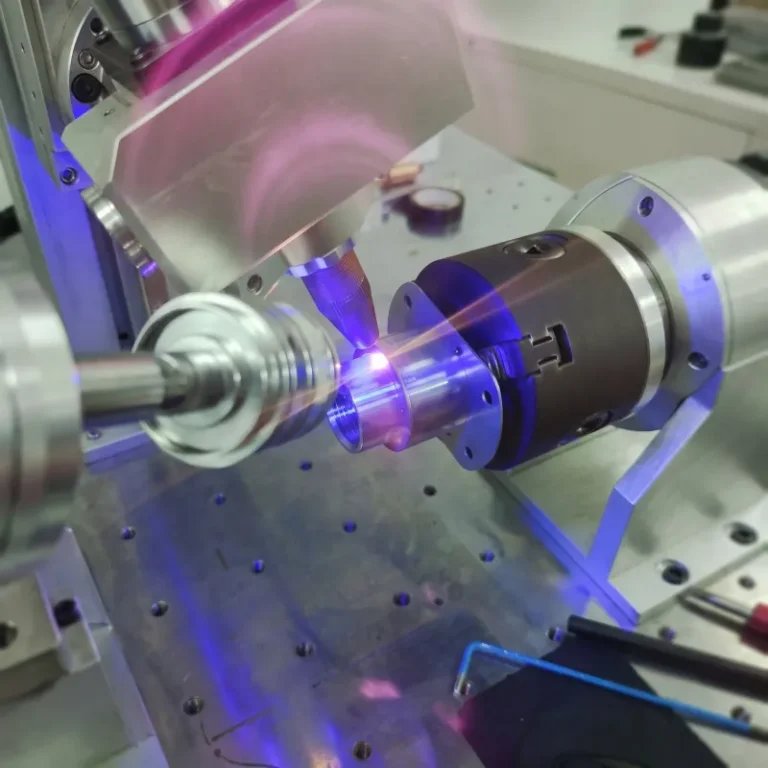
A laser does not need an arc, but the pool still needs shielding, and on aluminum that gas is argon. Nitrogen, a reasonable choice on stainless, is normally kept off aluminum because it reacts with the molten metal, and compressed air brings in oxygen and moisture together. What changes is the job the gas is part of: aluminum reflects much of the beam and conducts heat away quickly, so power, oscillation and wire matter as much as the gas does. The settings side is covered under aluminum laser welding.
On our handheld laser welders, the wire feeder runs 4043 aluminum wire in 1.0 to 1.2 mm as well as 5356, so the filler can be chosen for the alloy and the finish rather than for what the feeder will tolerate. The accessory kit includes four aluminum drive rolls, because soft wire run through rolls meant for steel wire gets crushed and starts to feed unevenly. The machine also raises an alarm when the gas runs low or cuts off. That matters more on aluminum than on most metals, since a bottle that empties mid-seam leaves a stretch of bead that looks finished and is not.
If you are setting up aluminum work for the first time, the alloy and the thickness decide most of it: the filler, whether argon alone is enough, and how much power the joint needs. Send the alloy, the thickness and what the part does in service, and we will send back a starting setup. Tell us the alloy
Reading the Bead When the Gas Is Wrong
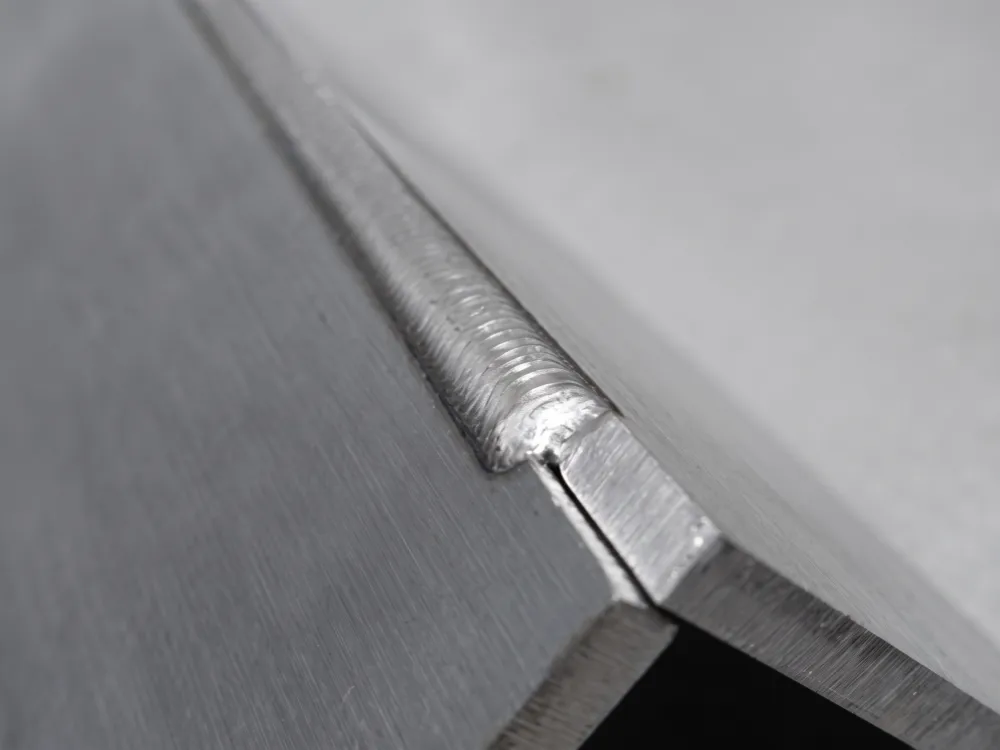
A black, sooty band that will not brush off, on a bead that also looks rough. Check the bottle label before anything else. A steel mix on an aluminum job is the classic cause, and swapping cylinders without purging the line can leave enough of the old gas in the hose to spoil the first seam.
A black film that wipes off easily, on an otherwise bright bead. Usually magnesium smut from 5356 wire rather than a gas fault.
A dull, frosted gray TIG bead. Coverage. Look at post-flow, the cup and any draft before touching the current.
Porosity on a joint where the gas checks out. The cause is usually upstream: oxide, oil or moisture left on the joint. The prep routine is set out step by step in how to clean aluminum before welding.
Common Questions
Can you weld aluminum with 75/25 argon–CO₂?
No; that mix is made for steel and will oxidize an aluminum pool.
Can you MIG weld aluminum without gas?
Not in any useful way. There is no gasless wire for aluminum in general use, so the shield has to come from a bottle of argon or an argon–helium blend.
What is aluminum welding called?
It has no separate name. The process names stay the same, TIG (gas tungsten arc welding), MIG (gas metal arc welding) or laser welding, and older welders sometimes still call aluminum TIG “heliarc,” from the days when helium was the usual shielding gas.
When is helium worth paying for?
Try a blend when a thick joint will not wet out without a long preheat, or when travel speed on heavy fillets is the bottleneck. Weld one test coupon on argon and one on the blend at the same settings, then section both; if fusion at the root does not improve, stay on argon.
What gas does a laser welder use on aluminum?
Argon. Keep nitrogen and compressed air for the metals they suit.
Related
Equipment
Further reading
- Cleaning Aluminum Before Welding
- Weld Porosity: What Causes It and How to Stop It
- MIG vs TIG Welding
Get in touch
- Tell us the alloy, along with the thickness and what the part has to do.