In short: Weld cracking happens when the metal in or beside a weld cannot stretch as far as the shrinking joint pulls it. Cracks that open while the weld is still freezing are hot cracks; cracks that appear after it has cooled, sometimes hours later, are cold cracks, and most of those are caused by hydrogen. Both need a susceptible metal and stress from shrinkage or restraint, and cold cracks also need something that makes the metal brittle as it cools.
A crack is never a cosmetic flaw. It is a sharp notch that keeps growing under load or vibration, which is why welding codes reject a crack of any length.
Hot Cracks and Cold Cracks
Hot cracking
As a weld pool freezes, grains grow in from both sides and meet along the middle. The last liquid to solidify collects there, and in steel it carries most of the sulfur and phosphorus because those elements lower its melting point. While that thin film is still liquid, the shrinking bead pulls on it and it tears. The result is a crack running down the centerline of the bead, visible as soon as the weld has cooled.
Bead shape makes it worse. A bead much deeper than it is wide forces the grains to meet in one narrow plane, exactly where the weakest liquid gathers. A concave fillet under heavy restraint does something similar, because its thin throat has to absorb all of the shrinkage.
Cold cracking
Cold cracks form after the weld has cooled, usually in the heat-affected zone beside or under the bead, or at the toe. They need hydrogen, a hard microstructure and stress at the same time. The hydrogen comes from moisture in flux or on the plate, from oil, grease and paint, or from damp gas lines. Hardenable steels form a brittle structure next to the weld when they cool quickly, and the hydrogen collects there and splits it.
Hydrogen takes time to move through steel, so these cracks can open well after the job looks finished. Shops that weld thick or high-strength carbon steel often hold the final inspection until the next day for exactly that reason.
Crater cracks
When the arc or beam stops abruptly, the pool at the end shrinks with nothing left to feed it and leaves a shallow dip that often cracks as a small star or a short line. A crater crack is a hot crack in miniature, and it is a common starting point for a longer crack that later runs back along the bead.
Why Some Metals Crack More Than Others
Aluminum alloys in the 6000 series are the best known case. Welded without filler, the weld metal lands in the composition range most prone to hot cracking, and the bead splits down the middle. A filler richer in silicon or in magnesium moves the weld out of that range, which is why autogenous welds on these alloys crack far more often than filled ones. How the filler and the shielding gas go together on aluminum is covered in our article on which gas suits aluminum welding.
Medium and high carbon steels, and many alloy steels, harden next to the weld and are the usual victims of cold cracking. The more carbon and alloy a steel carries, the more preheat and hydrogen control it needs.
Austenitic stainless steels such as 304 rarely suffer cold cracks but can hot crack if the weld metal freezes without a little ferrite in it. Standard stainless fillers are balanced to leave some ferrite in the bead for this reason, and a weld made with the wrong filler, or one diluted heavily by the base metal, can lose that margin.
Free-machining steels with added sulfur crack readily for the same reason, and so does any steel welded through paint, oil or plating, because the low-melting residue ends up in the last liquid to freeze.
How to Tell Which Crack You Have
Where and when the crack shows up tells you most of what you need. A crack straight down the middle of the bead that is there as soon as the part cools is a hot crack. A crack beside the bead, along the toe or in the base metal that appears later is almost always hydrogen. A star at the end of the run is a crater crack.
If you can break a cracked sample open, look at the faces. A hot crack usually shows dark, oxidized faces, because they formed while the metal was still glowing. A cold crack breaks bright and clean.
Fine cracks hide easily on a shiny stainless bead. Dye penetrant shows them clearly and costs little enough to use on the first part of every new job.
Preventing Cracks at the Joint
Against hot cracks, work on bead shape and composition. Aim for a bead at least as wide as it is deep, keep the face flat or slightly convex rather than concave, and add filler wherever the base metal on its own sits in a crack-prone range. Clean off paint, oil and coatings before welding, since their residues end up in the centerline.
Against cold cracks, work on hydrogen and cooling rate. Keep electrodes and flux dry, brush or grind the joint area bright, and preheat hardenable steel so the zone next to the weld cools more slowly. On heavy sections, a slow cool after welding gives the hydrogen time to escape before it does damage.
Against crater cracks, do not stop dead. Ramp the power down at the end of the seam, or step back a short distance onto the finished bead before you stop, so the last of the pool still has metal to draw on.
Restraint feeds all of them. A joint clamped hard on every side has nowhere to go as it shrinks, so the stress ends up in the weld. Sequence long seams so they can shrink freely, and avoid tacking every member of a fixture solid before the main joint is made.
Where Laser Welding Helps and Where It Needs Care
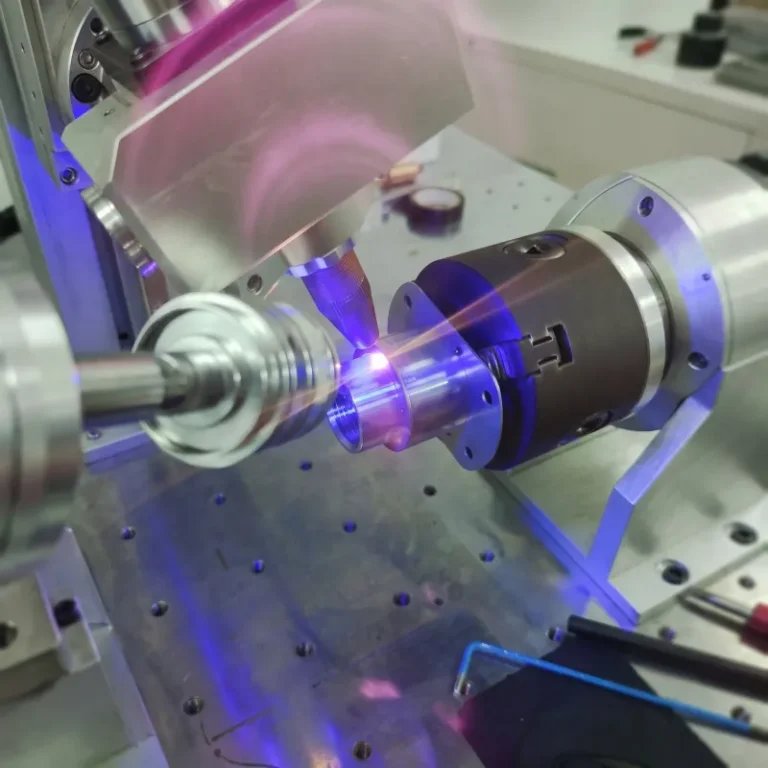
A laser beam concentrates its energy in a thin band, so the heat-affected zone is small and the part moves and pulls on the weld less than it would under a wide arc. That reduces the restraint stress behind many hot cracks. The same narrow zone cools quickly, though, and on hardenable steel a fast cool means a harder structure beside the weld, so hydrogen control and preheat still apply.
The other trap is bead shape. An autogenous laser weld tends to be deep and narrow, the shape most prone to centerline cracking, and on 6000-series aluminum it also has no filler to correct the composition. Running a handheld laser welder with wire on those alloys gives a wider bead and brings in the filler the joint is missing. Our pages on aluminum laser welding and on other metals by material list what each alloy needs.
Filler only helps if it arrives evenly. The wire feeder on our handheld machines is driven by a stepper motor through a planetary gearbox, which holds the wire speed steady as the load on the wire changes. For you, that means the share of filler in the bead stays the same from one end of the seam to the other, so the weld metal does not drift back toward the crack-prone range partway along.
If a weld keeps cracking in the same place, share a close-up picture of the crack, the alloy and its thickness, and a sketch of how the joint is clamped. We can say whether a change of filler, bead shape or heat input is likely to stop it, and whether a laser setup suits the part. Tell us where it cracks
Common Questions
Can a cracked weld be repaired?
Usually, once the cause is fixed. Grind the crack out completely, check with dye penetrant that none of it is left, then reweld with the change that stops it coming back; welding over a crack only buries it.
Why does my aluminum weld crack down the middle?
Most often because the alloy was welded without filler, or with too little of it, which leaves the weld metal in its most crack-prone range.
How long after welding can a crack appear?
Hydrogen cracks in hardenable steel can appear up to a day or two after welding.
Does preheating prevent cracking?
It prevents hydrogen cracking in hardenable steel by slowing the cool, but it does little for hot cracking, which depends on composition and bead shape.
Does laser welding cause more cracks than TIG?
Not as a rule. A laser weld brings less heat and distortion, but its narrow bead and fast cooling call for filler on crack-prone alloys and the usual hydrogen control on hardenable steel.
Related
Equipment
Further reading
Get in touch
- Tell us where it cracks, with the alloy and how the joint is clamped.